
Blog
Choosing Conservation: A Community’s Decision to Protect Its Wildlife
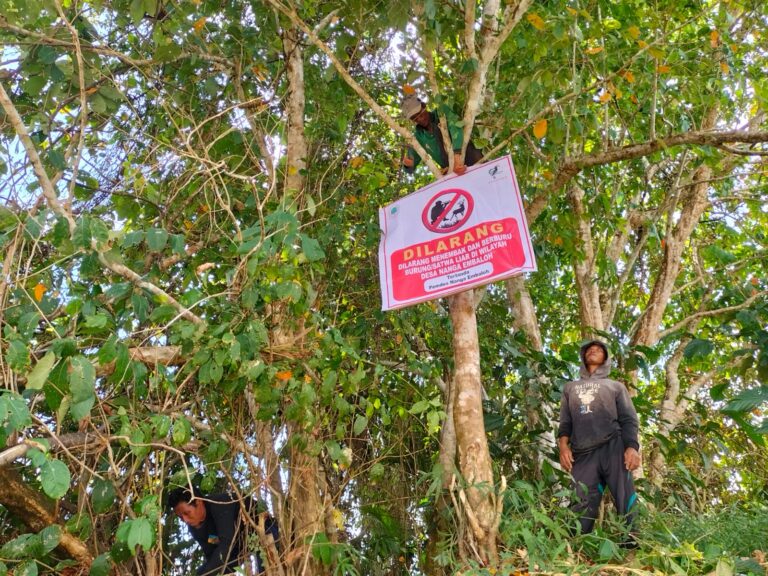
A sign of change: Nanga Embaloh’s self-imposed hunting ban protects wildlife and reflects growing community stewardship.
In the remote village of Nanga Embaloh, deep in West Kalimantan along the floodplain of the meandering Kapuas River, daily life has long been shaped by isolation, limited infrastructure, and reliance on the surrounding forest and rivers. But in late 2025, a quiet shift took place when a new and somewhat unconventional livelihood option, KehatiKu, arrived in Nanga Embaloh. What began as a way to supplement income has grown into something more: a community-driven effort to observe, value, and ultimately protect the wildlife that surrounds them.
Through this community-based wildlife monitoring system, villagers voluntarily submit observations and receive direct payments for verified wildlife recordings. With approximately 800 participants across nine villages, the programme generates around 200,000 wildlife observations each year. This volume of data is sufficient to develop occupancy estimates of wildlife occurrence and to measure change over time, and say something meaningful about wildlife populations.
In turn, KehatiKu empowers communities to monitor their own wildlife, become custodians of their wildlife data, and strengthen their position in discussions with government and private sector actors when decisions about the future of their forests and land are made.
This model is already shaping how communities like Nanga Embaloh perceive wildlife and interact with their environment to the point where wildlife becomes a village asset worth protecting.
A Remote Community, A New Opportunity
Nanga Embaloh is a rural village in the Embaloh Hilir District of Kapuas Hulu Regency in West Kalimantan, with limited connectivity to other villages and larger towns. For years, the village has been advocating for a 31 km road to connect it to Nanga Mandai, a nearby village, but substantial budget constraints have hindered development.
The village is home to 1,236 inhabitants across 350 households. The average monthly income is Rp 1,500,000 (approximately USD 88.50), although high-earning kratom farmers can earn between USD 544 and USD 690 per month during harvest times (Supriadi et al., 2023).
Before 2017, many villagers were rubber farmers and fishermen, but there was a significant shift towards kratom farming. Kratom is a tropical tree native to Southeast Asia, harvested for its stimulant and sedative properties. In powdered form, it sells for USD 6–15 per 30 g in international markets.
Since 2023, Nanga Embaloh has been participating in the national ‘Kampung Nelayan Merah Putih’ programme, which aims to develop and modernise coastal and fishing villages into more productive and integrated settlements. KehatiKu now offers a reliable primary or secondary income to villagers, who can voluntarily collect wildlife observations at their convenience.
New Livelihood Options in Nanga Embaloh
Bapak Toni Espendi is a committed, regular KehatiKu contributor, despite having only started submitting observations in late 2025. He first heard of the initiative from Borneo Futures’ local facilitator, Andi Erman, and people from the neighbouring village, Nanga Palin, which first started participating in KehatiKu in May 2025.
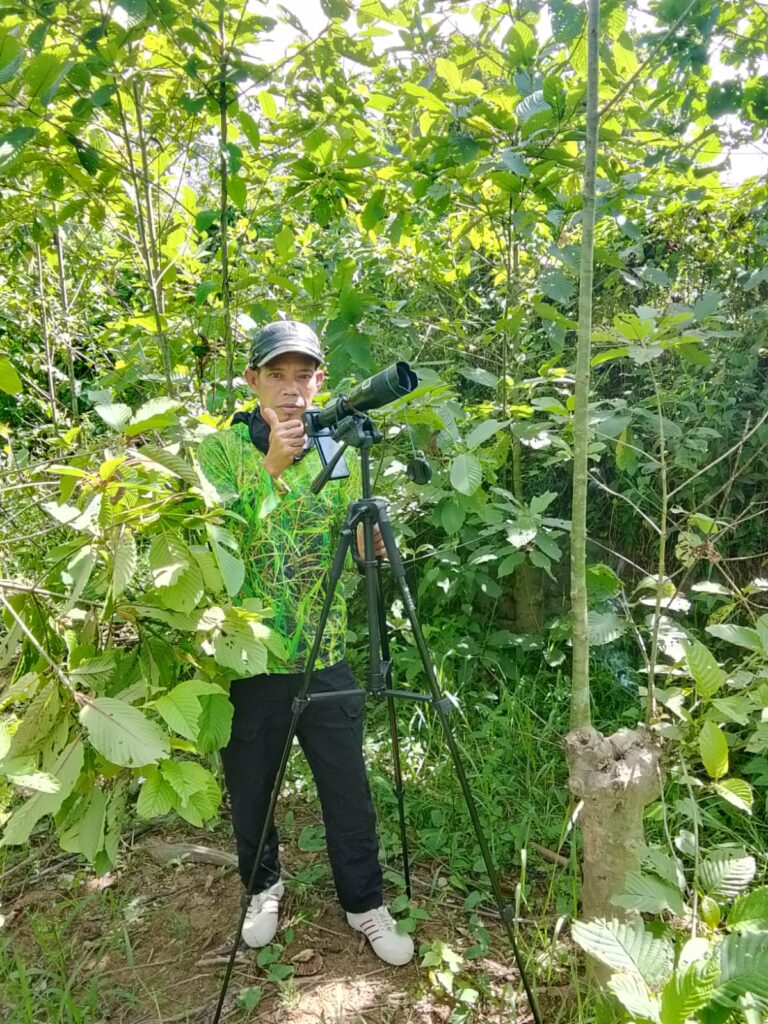
He tells us that before he first started submitting observations, he rarely went into the forest. However, once he began to learn more about local species and where they could be found, making observations became part of his daily routine.
Being particularly interested in birds, Pak Toni typically sets off early in the morning to look for species in the forest and returns around noon. He then goes out again in the afternoon and ends his ‘shift’ at sunset. Through months of careful observation, he has managed to pinpoint the times and locations where species are most common, making his trips to the forest fruitful opportunities for additional income alongside his main occupation, farming.
“Economically, it helps support my children and household needs – covering school expenses, food, electricity, and other daily necessities. The additional income also motivates me to continue making observations. I also bought four camera lenses with my earnings, which have really helped improve the quality of the photos I take.”
Another interviewee from Nanga Embaloh, Ibu Susi, short for Susilawati, also used her income from KehatiKu to purchase a camera lens to improve the quality of her observations and increase the proportion of which she received payment.
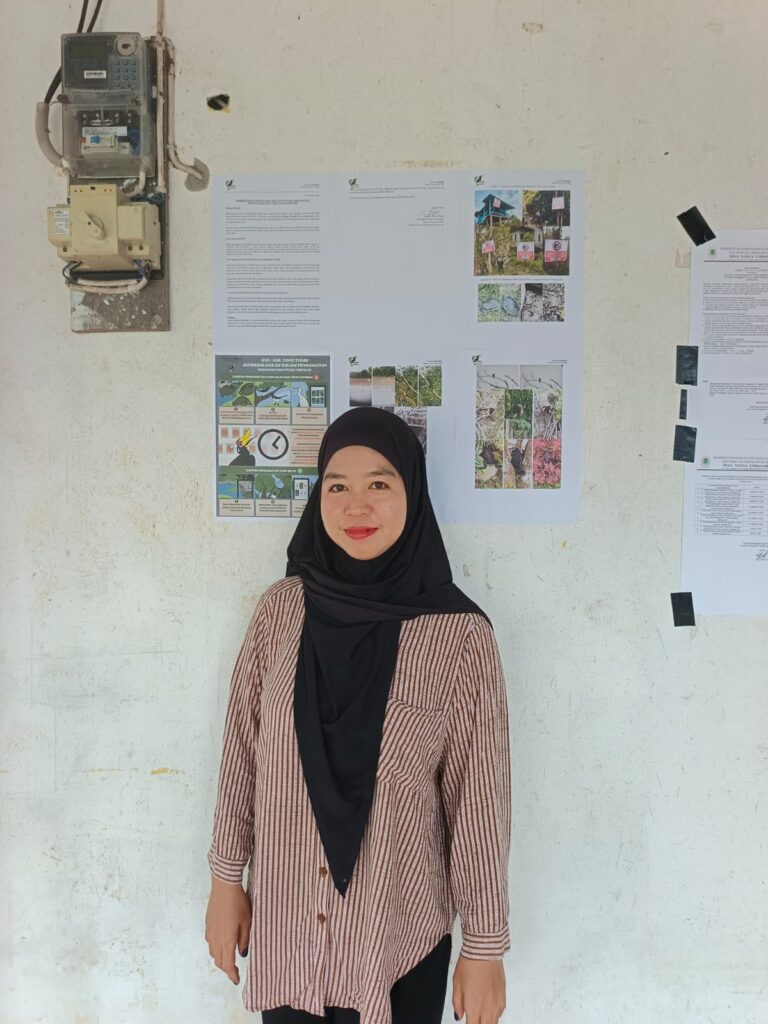
She tells us that the lens has been very useful for her and has allowed her to earn a meaningful income alongside her farming work. She usually makes observations while accompanying her husband at the farm or on days off.
“At first, I did not know much about birds or wildlife. As a woman, I rarely entered the forest. But since this program started, I have become more aware and curious about the birds that exist around us.”
She lights up when asked about her most memorable observation.
“My friends and I found a drongo and a hornbill. It was my first time seeing a drongo, so I felt quite proud. I hope the program can continue because it provides benefits and encourages people to participate.”
Pak Toni shares this enthusiasm, with his proudest observation being that of a hornbill, as they are rare, difficult to photograph, and often perched in tall trees.
Choosing Conservation
What currently sets Nanga Embaloh apart from other villages involved with KehatiKu is the autonomous declaration of a hunting ban in the area, in response to high community involvement and recognition of the resulting community-wide socioeconomic benefits.
In February 2026, village representatives called for a meeting with the village head, head of the subdistrict and representatives from the army and police. They wanted to know whether it is legally possible to ban outsiders and villagers from hunting or collecting wildlife. As wildlife is now an important source of income, they did not want anyone to reduce the populations.
In the meeting, it was decided that a local hunting ban was indeed legal. The villagers then came together, each contributing a small amount, to fund and install signs and banners. Proudly displayed throughout the village, these announcements declared their commitment to protecting the forest and the wildlife they share it with.
The introduction of a ban has had direct, observable benefits for both the community and biodiversity. Both of our interviewees remarked that they feel safer in the forest, noting that villagers often felt apprehensive when harvesting kratom – a major source of income for the community – due to the fear of encountering hunters while at work.
The decrease in hunting activities is already thought to have had a noticeable impact on local wildlife presence. In comparison to when he first started making observations, only a few months before being interviewed, Pak Toni recognises a greater presence of hornbills around village areas—a species which, until recently, was very elusive and hard to spot.
“I feel that protecting the forest is very important because many animals are now rarely seen, such as hornbills. In the past, there were many close to the village, but now they are mostly found farther away. Since the hunting ban was put in place, hornbills have started to become less afraid and sometimes come down near the lake. In the past, they were very shy. We also see mayas (orangutans).”
A Model for Community-Led Change
The aim of KehatiKu is for conservation to become a locally self-sustaining initiative. We believe that when communities take ownership of decisions made about their environment, recognising the immediate benefits they reap from protecting species, it supports the long-term sustainability of the initiative.
Fundamentally, KehatiKu relies on perception changes within communities. When communities self-organise conservation initiatives, such as the Nanga Embaloh hunting ban, there is no need for guidance from outside experts, which again lowers costs and improves scalability, and ultimately makes KehatiKu self-sustaining.
With much of current uptake originating from inter-village communication and positive testimonies from observers who see the value of the programme for their personal, family, and local economy, we believe that KehatiKu can and will scale, and, when it hopefully receives adequate private or public support to facilitate large scale automated digital payments, be implemented across Indonesia, a nation of rich biodiversity and untapped conservation potential.
For villagers like Pak Toni, however, the impact is already tangible in their daily lives:
“We are very thankful for this program because it helps our family’s economy a lot. In Nanga Embaloh, people are now very enthusiastic and go out every morning to do observations. After this interview, I will go out again to look for birds. It has become a routine because it is very helpful.”
Personal stories and photographs in this article are shared with the explicit consent of the individuals involved