
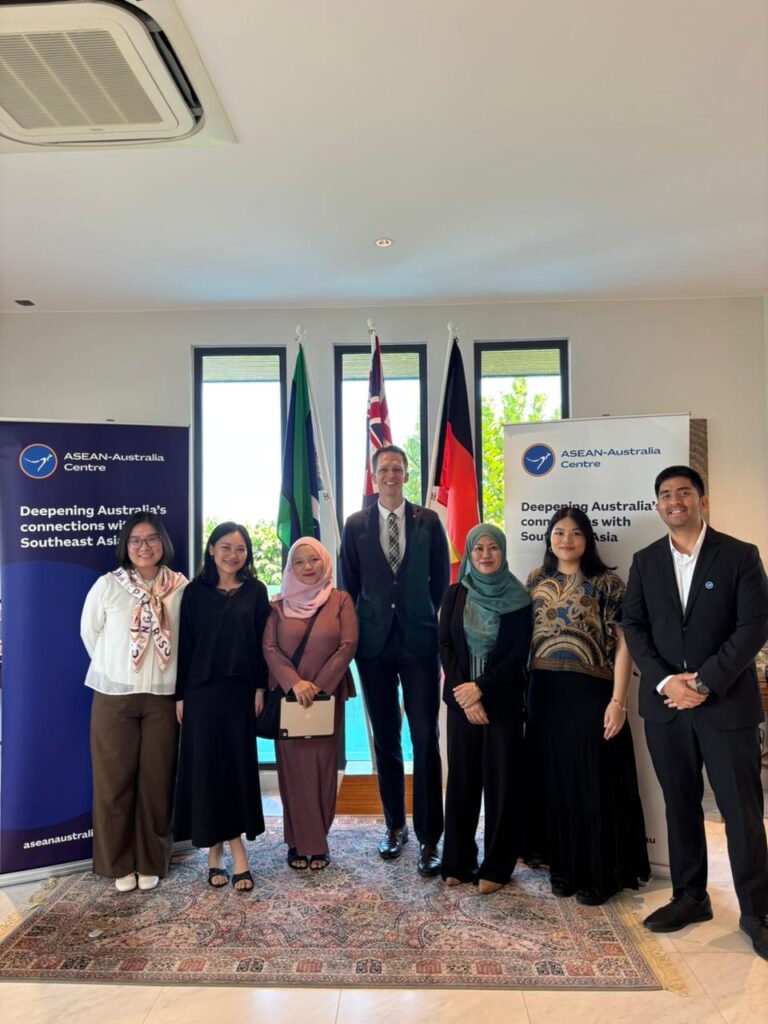
As an inspiring young member of Borneo Futures’ team, Bazilah Fakhri‘s work sits at the intersection of biodiversity, community engagement, and environmental sustainability. With a background in biology and a passion for youth leadership and environmental advocacy, she contributes to both the KehatiKu citizen science programme and the organisation’s communications efforts, helping to connect people with nature through data, storytelling, and outreach.
Recently, Bazilah was selected as one of three representatives from Brunei to participate in a 12-week short course on sustainable agriculture and food systems hosted by the ASEAN-Australia Centre and the University of Queensland. Combining intensive online learning, collaborative group activities, and a study tour to Queensland, the programme brought together participants from across ASEAN to explore the complex relationships between food, climate, policy, and people.
The in-person component included visits to livestock farms, food production facilities, research centres, North Stradbroke Island (Minjerribah), and the University of Queensland’s Gatton campus. For Bazilah, these experiences transformed classroom concepts into tangible realities.
One visit that left a particularly strong impression was a tour of the ACC feedlot and abattoir. Observing the scale and complexity of food production firsthand gave her a new appreciation for the systems, processes, and people involved in supplying food to large populations.
Standing inside the high-capacity Australian abattoir, Bazilah was struck not only by the sheer scale of food production but by the systems that make it possible, from sanitation protocols and biosecurity measures to the labour and logistics behind feeding entire populations.
“The abattoir was honestly a highlight,” she tells me. “It was confronting, but fascinating. Seeing how structured everything was – the sanitation, the biosecurity, the whole process, really changed the way I think about where food comes from.”
That feeling of confrontation continued throughout the trip. At a large-scale feedlot, where thousands of cattle were separated into plots stretching across the landscape, the magnitude of industrial agriculture became impossible to ignore.
“There were no pictures allowed, but just seeing the scale of it in real life was shocking,” she says. “You understand food systems intellectually, but then you stand there and realise how massive these systems really are.”

Inspired by her colleague, Safwanah, who had attended a course provided by the same hosts in 2025, Bazilah applied to be one of just three participants selected to represent Brunei alongside delegates from across ASEAN. With a background in biodiversity and community-led conservation work in Brunei, she joined the programme to deepen her understanding of the relationship between food systems, policy, and people.
The application process was rigorous, she says, and she was surprised to have been selected alongside two professionals working directly in agriculture: an assistant professor from Universiti Teknologi Brunei (UTB) and an associate researcher at the Centre for Strategic and Policy Studies (CSPS).
In her application essay, Bazilah explored themes closely tied to KehatiKu, the community-based biodiversity monitoring system spearheaded by Borneo Futures. She incorporated ideas around regenerative farming, Traditional Ecological Knowledge, and smallholder farmers’ inclusion in project development, recognising the inherent interconnectedness of environmental, agricultural, and social systems.
The course itself took place over 12 weeks, with 7 weeks conducted online before culminating in a one-week intensive programme in Australia. The lectures focused heavily on systems thinking, encouraging participants to understand food systems not as isolated issues, but as interconnected networks shaped by policy, climate, economics, and people.
During the in-person component, participants visited The University of Queensland’s Gatton campus, livestock farms, food production facilities, and research sites, gaining firsthand insight into how classroom concepts are applied in practice. One particularly memorable excursion was to North Stradbroke Island (Minjerribah), where participants explored culturally and environmentally significant sites, including Brown Lake (Bummiera) and Myora Springs (Capemba). The visit provided an opportunity to learn about the island’s history, Indigenous Knowledge systems, and the importance of territorial acknowledgement, while also discovering native flora and their traditional Aboriginal uses, including the versatile Banksia flower.
Still, many of the programme’s most impactful lessons came from discussions around climate resilience and climate-smart agriculture, particularly the role of smallholder farmers and stakeholder inclusion; themes Bazilah immediately connected back to Borneo Futures’ work in rural Borneo through KehatiKu.
One lecture that especially resonated with her was led by Dr Natalie Jones, who spoke about the importance of people-centred approaches in agriculture and development work. The session focused on how farmers and marginalised groups are often excluded from policy conversations despite being the people most directly affected by them.
Of particular interest to Bazilah was a case study on empowering women in the forestry and timber industries in rural Fiji through an “interpretivist” approach, which worked to bridge communication gaps between farmers and government stakeholders. Dr Jones also discussed the Gender Equality, Disability, and Social Inclusion (GEDSI) framework, and how systems thinking can be used to create more inclusive policies through collaboration between multi-stakeholder and participatory approaches to co-design sustainable farming innovations.

For Bazilah, the biggest takeaway was ultimately one of self-reflection.
“One thing that really stayed with me was a quote that ‘if it’s not with them, it’s not about them” she says. “It made me think more deeply about involving farmers, who are the backbone of the agriculture and food system, as well as youth, because we’re the next generation who will inherit these challenges. We need to work alongside each other, rather than above or behind, to prepare and adapt for climate change.”
Returning home to Brunei, Bazilah immediately began work on her final capstone project, inspired by the lessons she had learned throughout the programme. The project took the form of a policy dialogue workshop for youth members of the World Food Forum Brunei, an organisation she had already been involved with before attending the course.
The workshop focused on the main challenges within Brunei’s agricultural and food systems, particularly the lack of youth participation and engagement in policymaking.
“There is a lack of policy awareness and literacy among youth, since the system has limited youth representation in policy and decision-making, making it feel fragmented and inaccessible to us youths”, she explains.

To explore these issues, Bazilah gave pre- and post-workshop surveys to evaluate participants’ understanding of agriculture and food systems and policy in Brunei. She also delivered a presentation on key national challenges, including Brunei’s heavy reliance on imported food (approximately 96%), as well as land accessibility issues, labour force development, youth participation, and climate change impact on agriculture. Participants then worked through brainstorming exercises using systems thinking approaches before developing policy recommendations of their own.
“Younger generations are yappers,” she laughs. “Once you create a third safe space for them, there are so many things they want to talk about.”
The response to the workshop was overwhelmingly positive, and for Bazilah, it reinforced the importance of creating spaces where youth feel empowered to participate in conversations about agriculture, food security, and sustainability.
“This is just one first step,” she says. “But it shows how much potential there is moving forward if people like us are given the opportunity to engage in the agriculture system.”